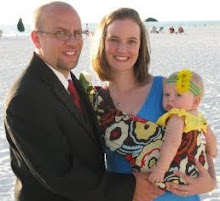
And for fun, here are some new pictures of Laurel (which I know is the real reason people look at this blog!)
Good News
And for fun, here are some new pictures of Laurel (which I know is the real reason people look at this blog!)
So is she eating "real food" yet?
- World Health Organization
- UNICEF
- US Department of Health & Human Services
- American Academy of Pediatrics
- American Academy of Family Physicians
- American Dietetic Association
Yet, most people seem to think that breastmilk isn't "real food" and that it won't sustain a baby past three or four months. Every family has to look at the research and do what works for their family, but here are the reasons that we are delaying solids. (Most of this information comes from http://www.kellymom.com/ and http://www.askdrsears.com/)
Delaying solids gives baby greater protection from illness.
Although babies continue to receive many immunities from breastmilk for as long as they nurse, the greatest immunity occurs while a baby is exclusively breastfed. Breastmilk contains 50+ known immune factors, and probably many more that are still unknown.
Delaying solids gives baby's digestive system time to mature.
If solids are started before a baby's system is ready to handle them, they are poorly digested and may cause unpleasant reactions (digestive upset, gas, constipation, etc.). Protein digestion is incomplete in infancy.
Delaying solids decreases the risk of food allergies. (particularly important to us because both Tim and I have some food allergies)
It is well documented that prolonged exclusive breastfeeding results in a lower incidence of food allergies. From birth until somewhere between four and six months of age, babies possess what is often referred to as an "open gut." This means that the spaces between the cells of the small intestines will readily allow intact macromolecules, including whole proteins and pathogens, to pass directly into the bloodstream. This is great for your breastfed baby as it allows beneficial antibodies in breastmilk to pass more directly into baby's bloodstream, but it also means that large proteins from other foods (which may predispose baby to allergies) and disease-causing pathogens can pass right through, too. During baby's first 4-6 months, while the gut is still "open," antibodies (sIgA) from breastmilk coat baby's digestive tract and provide passive immunity, reducing the likelihood of illness and allergic reactions before gut closure occurs. Baby starts producing these antibodies on his own at around 6 months, and gut closure should have occurred by this time also.
Delaying solids helps to protect baby from future obesity.
The early introduction of solids is associated with increased body fat and weight in childhood.
Delaying solids helps mom to maintain her milk supply.
Studies have shown that for a young baby solids replace milk in a baby's diet - they do not add to baby's total intake. The more solids that baby eats, the less milk he takes from mom, and less milk taken from mom means less milk production. Babies who eat lots of solids or who start solids early tend to wean prematurely.
Delaying solids allow babies to lose the tongue-thrust reflex.
In the first four months the tongue thrust reflex protects the infant against choking. When any unusual substance is placed on the tongue, it automatically protrudes outward rather than back. Between four and six months this reflex gradually diminishes, giving the glob of cereal a fighting chance of making it from the tongue to the tummy.
These are some of the reasons that we will be waiting until Laurel is at least six months old to try solid foods.
First trip out of state
Here are some pictures:
Hi, my name is Sarah and I am a lactator
My particular future concerns right now are teething, introducing solids and her eventual weaning. Some moms have told me that they hardly even noticed when their little ones were teething and others have said that there nipples were used as chew toys (OUCH!) She is getting to that age where she is drooling a lot and while I don't think any teeth are on the verge of popping through, I know they will be here soon enough.
My aim as far as introducing solids is to really let Laurel dictate when she's ready. In the past week we've noticed her watching us eat for the first time, so I have a feeling swiping table food won't be far behind. There is so much contrasting information out there about what the best first foods are. Our pediatrician recommends cereal but others recommend high calorie veggies. I'm still not sure what I'm comfortable doing first, but I'll keep you updated :)
Since long before I was pregnant, I knew I wanted to breastfeed. At first, I thought I would just do it for six months. Then after reading up on the subject, I changed my goal to one year (the recommendation of the American Academy of Pediatrics). Now, I'm leaning toward baby-led weaning, with the idea being that I'll breastfeed as long as Laurel wants to and allow her to wean on her own. Baby-led weaning is a scary proposition for me because I don't want to be that "weirdo" breastfeeding her three or four year old. However, there are so many advantages to extended breastfeeding (http://www.kellymom.com/bf/bfextended/ebf-benefits.html) and the World Health Organization recommends nursing to at least two years of age and longer if desired by mom and child. I love that I can nourish my baby with so many wonderful nutrients as well as provide her with antibodies to prevent her from getting sick. There are also so many benefits to women who breastfeed for a longer period of time (plus, ovulation is suppressed, so no worries about cycles.)
During that meeting we discussed some of the pitfalls of breastfeeding and some of the ways that other people can damage your breastfeeding relationship with your child. It was great to hear other voices and to find common ground with other women.
At the Attachment Parenting International (API) meeting (the two meetings are in the same room and run back-to-back), we talked about how to defend your parenting choices. In this area, breastfeeding rates are well below the national average, and those that do breastfeed generally wean before six months and it is almost unheard of to breastfeed beyond one year old. Babywearing is very rare. Also, cosleeping is generally frowned on and unfortunately most parents use Cry It Out methods to get their babies to sleep through the night.
I feel so fortunate that these two groups have started here. I often feel quite alone in my parenting decisions and while I'm alright with that and won't be pressured to change because of others, it is still nice to join with like-minded families who share my beliefs that attachment parenting and breastfeeding are the best starts we can give our children.
Cloth Diapers? Why?
But the real question is, "How big of a hassle are they to keep clean?" (Especially for some one who doesn't like to do laundry a lot.) Really, they aren't a big deal to keep clean (we've even had a poopy diaper). I just put them in a bag when they are soiled, and at the end of the day they go in the washer on a cold wash with no detergent (this is if there is a dirty diaper, otherwise I skip this step), then I do a warm wash with a fourth of a cup of detergent. After that, put them in the dryer and that's it. And the cloth diapers we got are so cute and easy to put on. We got a couple of pre-folds with the trial set (these are the white rectangles of cloth that our moms used) and I can't really figure them out. So far the Bumgenius diapers are our faves, but we still have two more weeks to try them out, so we'll see if they stay on top.
Here's a picture of Laurel in a Thirsties diaper.
Water Baby
Amy had the most adorable swimsuit for her to wear. It was a size six months, and bless her heart, we could barely get it over her chunky little thighs.
Here's the baby float. She did pretty well in it when Tim held her feet underneath and pushed her up a little.Picky Sleeper
Since she was born, I've never tried to put her on a schedule with the belief that babies' needs change very quickly and I didn't want to become dependent on a clock to tell me what she needed rather than watching for her cues and relying on my own, God-given intuition. That strategy has worked so well because she has formed her own routine, one that she is thriving with and one that myself, my mom and my mother-in-law are able to meet her needs with by paying attention to her cues without the need for much crying or frustration. Therefore, we are all happy to accomodate her needs for sleep (as varied as they may be) because she has no capacity to manipulate - she simply knows when she's content and when she's not. It is our responsibility as her caretakers to keep her content as best we can.
Monday, July 20, 2009
Good News
Thursday, July 9, 2009
So is she eating "real food" yet?
- World Health Organization
- UNICEF
- US Department of Health & Human Services
- American Academy of Pediatrics
- American Academy of Family Physicians
- American Dietetic Association
Yet, most people seem to think that breastmilk isn't "real food" and that it won't sustain a baby past three or four months. Every family has to look at the research and do what works for their family, but here are the reasons that we are delaying solids. (Most of this information comes from http://www.kellymom.com/ and http://www.askdrsears.com/)
Delaying solids gives baby greater protection from illness.
Although babies continue to receive many immunities from breastmilk for as long as they nurse, the greatest immunity occurs while a baby is exclusively breastfed. Breastmilk contains 50+ known immune factors, and probably many more that are still unknown.
Delaying solids gives baby's digestive system time to mature.
If solids are started before a baby's system is ready to handle them, they are poorly digested and may cause unpleasant reactions (digestive upset, gas, constipation, etc.). Protein digestion is incomplete in infancy.
Delaying solids decreases the risk of food allergies. (particularly important to us because both Tim and I have some food allergies)
It is well documented that prolonged exclusive breastfeeding results in a lower incidence of food allergies. From birth until somewhere between four and six months of age, babies possess what is often referred to as an "open gut." This means that the spaces between the cells of the small intestines will readily allow intact macromolecules, including whole proteins and pathogens, to pass directly into the bloodstream. This is great for your breastfed baby as it allows beneficial antibodies in breastmilk to pass more directly into baby's bloodstream, but it also means that large proteins from other foods (which may predispose baby to allergies) and disease-causing pathogens can pass right through, too. During baby's first 4-6 months, while the gut is still "open," antibodies (sIgA) from breastmilk coat baby's digestive tract and provide passive immunity, reducing the likelihood of illness and allergic reactions before gut closure occurs. Baby starts producing these antibodies on his own at around 6 months, and gut closure should have occurred by this time also.
Delaying solids helps to protect baby from future obesity.
The early introduction of solids is associated with increased body fat and weight in childhood.
Delaying solids helps mom to maintain her milk supply.
Studies have shown that for a young baby solids replace milk in a baby's diet - they do not add to baby's total intake. The more solids that baby eats, the less milk he takes from mom, and less milk taken from mom means less milk production. Babies who eat lots of solids or who start solids early tend to wean prematurely.
Delaying solids allow babies to lose the tongue-thrust reflex.
In the first four months the tongue thrust reflex protects the infant against choking. When any unusual substance is placed on the tongue, it automatically protrudes outward rather than back. Between four and six months this reflex gradually diminishes, giving the glob of cereal a fighting chance of making it from the tongue to the tummy.
These are some of the reasons that we will be waiting until Laurel is at least six months old to try solid foods.
Sunday, June 28, 2009
First trip out of state
Here are some pictures:
Monday, June 15, 2009
Hi, my name is Sarah and I am a lactator
My particular future concerns right now are teething, introducing solids and her eventual weaning. Some moms have told me that they hardly even noticed when their little ones were teething and others have said that there nipples were used as chew toys (OUCH!) She is getting to that age where she is drooling a lot and while I don't think any teeth are on the verge of popping through, I know they will be here soon enough.
My aim as far as introducing solids is to really let Laurel dictate when she's ready. In the past week we've noticed her watching us eat for the first time, so I have a feeling swiping table food won't be far behind. There is so much contrasting information out there about what the best first foods are. Our pediatrician recommends cereal but others recommend high calorie veggies. I'm still not sure what I'm comfortable doing first, but I'll keep you updated :)
Since long before I was pregnant, I knew I wanted to breastfeed. At first, I thought I would just do it for six months. Then after reading up on the subject, I changed my goal to one year (the recommendation of the American Academy of Pediatrics). Now, I'm leaning toward baby-led weaning, with the idea being that I'll breastfeed as long as Laurel wants to and allow her to wean on her own. Baby-led weaning is a scary proposition for me because I don't want to be that "weirdo" breastfeeding her three or four year old. However, there are so many advantages to extended breastfeeding (http://www.kellymom.com/bf/bfextended/ebf-benefits.html) and the World Health Organization recommends nursing to at least two years of age and longer if desired by mom and child. I love that I can nourish my baby with so many wonderful nutrients as well as provide her with antibodies to prevent her from getting sick. There are also so many benefits to women who breastfeed for a longer period of time (plus, ovulation is suppressed, so no worries about cycles.)
During that meeting we discussed some of the pitfalls of breastfeeding and some of the ways that other people can damage your breastfeeding relationship with your child. It was great to hear other voices and to find common ground with other women.
At the Attachment Parenting International (API) meeting (the two meetings are in the same room and run back-to-back), we talked about how to defend your parenting choices. In this area, breastfeeding rates are well below the national average, and those that do breastfeed generally wean before six months and it is almost unheard of to breastfeed beyond one year old. Babywearing is very rare. Also, cosleeping is generally frowned on and unfortunately most parents use Cry It Out methods to get their babies to sleep through the night.
I feel so fortunate that these two groups have started here. I often feel quite alone in my parenting decisions and while I'm alright with that and won't be pressured to change because of others, it is still nice to join with like-minded families who share my beliefs that attachment parenting and breastfeeding are the best starts we can give our children.
Sunday, June 7, 2009
Cloth Diapers? Why?
But the real question is, "How big of a hassle are they to keep clean?" (Especially for some one who doesn't like to do laundry a lot.) Really, they aren't a big deal to keep clean (we've even had a poopy diaper). I just put them in a bag when they are soiled, and at the end of the day they go in the washer on a cold wash with no detergent (this is if there is a dirty diaper, otherwise I skip this step), then I do a warm wash with a fourth of a cup of detergent. After that, put them in the dryer and that's it. And the cloth diapers we got are so cute and easy to put on. We got a couple of pre-folds with the trial set (these are the white rectangles of cloth that our moms used) and I can't really figure them out. So far the Bumgenius diapers are our faves, but we still have two more weeks to try them out, so we'll see if they stay on top.
Here's a picture of Laurel in a Thirsties diaper.
Sunday, May 31, 2009
Water Baby
Amy had the most adorable swimsuit for her to wear. It was a size six months, and bless her heart, we could barely get it over her chunky little thighs.
Here's the baby float. She did pretty well in it when Tim held her feet underneath and pushed her up a little.Saturday, May 30, 2009
Picky Sleeper
Since she was born, I've never tried to put her on a schedule with the belief that babies' needs change very quickly and I didn't want to become dependent on a clock to tell me what she needed rather than watching for her cues and relying on my own, God-given intuition. That strategy has worked so well because she has formed her own routine, one that she is thriving with and one that myself, my mom and my mother-in-law are able to meet her needs with by paying attention to her cues without the need for much crying or frustration. Therefore, we are all happy to accomodate her needs for sleep (as varied as they may be) because she has no capacity to manipulate - she simply knows when she's content and when she's not. It is our responsibility as her caretakers to keep her content as best we can.